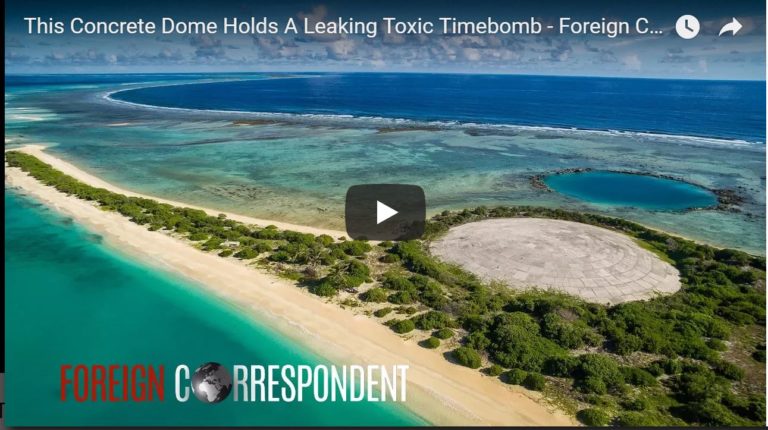
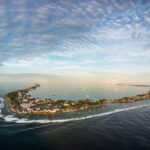
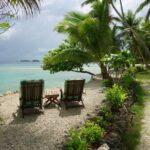
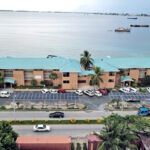
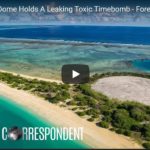
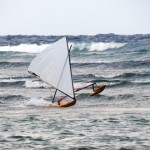
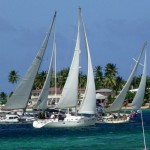
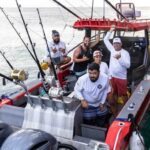
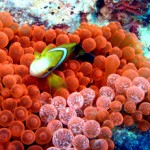
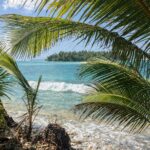
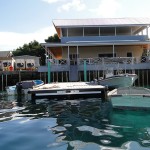
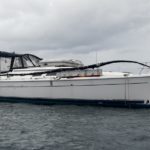
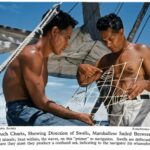
November, 2017: While filming for the story on the nuclear waste dump in the Marshall Islands, the ABC’s Foreign Correspondent team of Mark Willacy, Greg Nelson, and Ben Hawke amassed more visuals than they could use in the episode. So here, for your viewing pleasure today, is a compilation of the best shots they captured from their time in the Micronesian string of islands entitled ‘Marshall Islands From Above’.
And now watch the whole episode, A Poison in My Island:
Follows is the back story about the ABC team’s time in the Marshall Islands:
Surviving Snoring and Spam
Mark Willacy on assignment in the Marshall Islands for the
Australian Broadcasting Corporation’s Foreign Correspondent
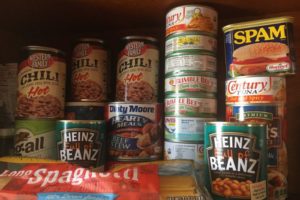
It was certainly not a diet conducive to a harmonious and flatulence-free household, especially for three grown men in such close quarters. Stacked before us in our kitchen cupboard were towers of baked beans, hearty beef stew, spicy tuna, hot chili beans, and the national dish of the Marshall Islands — Spam.
This was what producer Ben Hawke, camera operator Greg Nelson, and I would be feasting on for the next week. These were our supplies, flown in from the Marshall Islands capital Majuro 1,500 kilometres to the east over the vast, deep Pacific. Our home was a rickety demountable building on the main island of Enewetak Atoll.
This coral and sand speck was once part of the rim of an ancient sea volcano in the central Pacific. Like much of the Marshall Islands it was barely a metre above sea level. The lip of Enewetak’s sunken volcano now forms the world’s second largest ocean lagoon, its spectacular azure waters are straight out of a tourist brochure for an unspoiled Pacific paradise.
But this lagoon hides a dark, dirty secret. Its depths harbor one of the most toxic substances on the planet — plutonium. That’s why we had come to Enewetak.
This atoll had been the scene of 43 United States atomic tests during the 1940s and 50s. Some were so big, whole islands had been vaporised by the blasts, one by a thermonuclear bomb called “Ivy Mike”. Despite its rather benign-sounding name, Ivy Mike lit up Enewetak on November 1, 1952, its fireball spawning a mushroom cloud 160 kilometers across. The blast left a 2km-wide crater where the island of Elugelab had been just moments before…
To read the full story and see Greg’s gorgeous photos, go to the following link and search for the words poison in my island:
Surviving snoring and Spam in the Marshall Islands