Bwiro: Breadfruit Leaves vs. Tinfoil
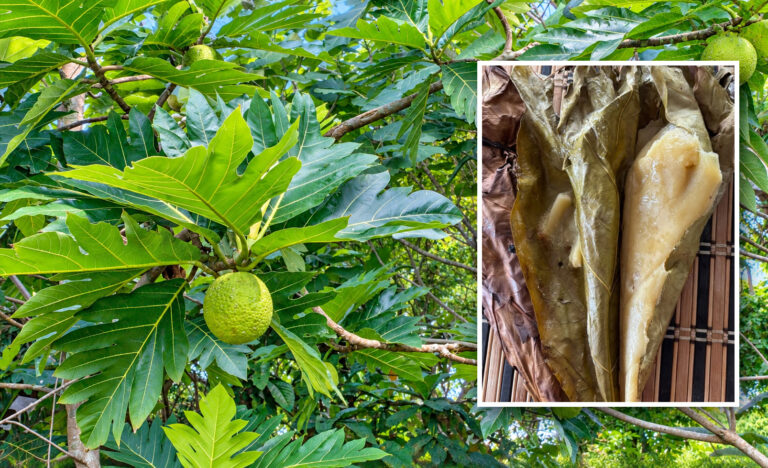
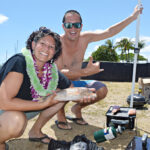
Preserved breadfruit cooked the island way, in double breadfruit leaves tied with coconut-frond string, alongside a modern tinfoil version. Tap any photo to enlarge.
Photos: Giff Johnson
Photo: Giff Johnson


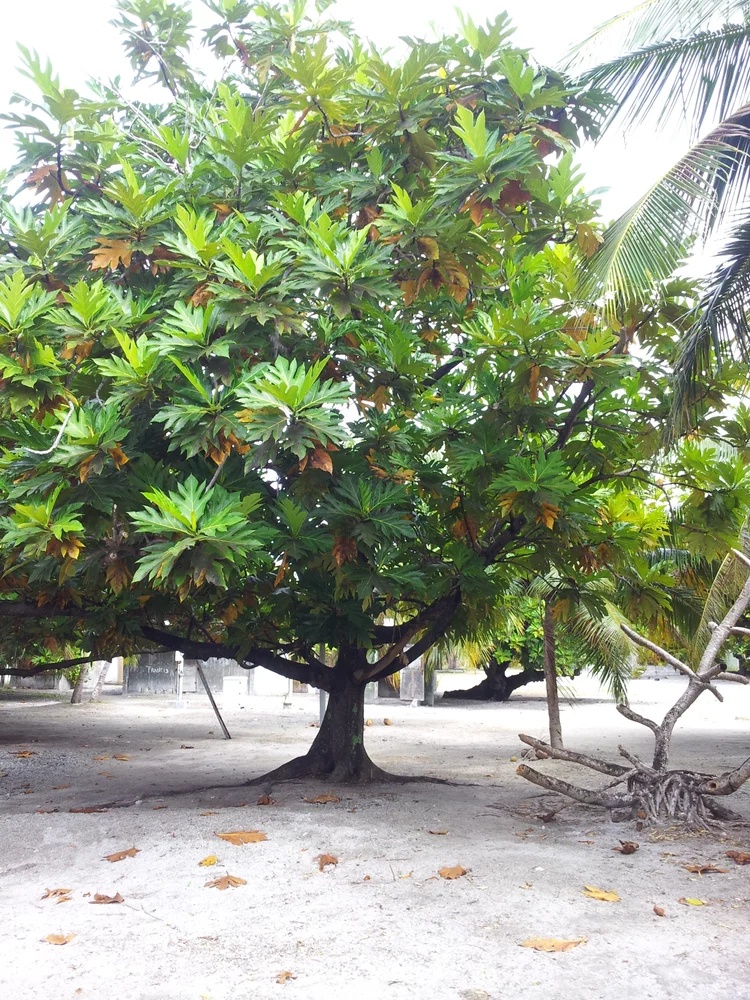
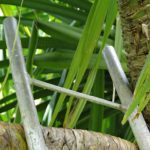
Breadfruit (mā) tree on Wotho Atoll. Photo: Majuro Conservation Society
Breadfruit and the Legend of Inedel
Inedel told her the truth. His stepmothers fed him fish bones and the hard top stem of the breadfruit, and sometimes a tiny fish called alle dikdik. His mother begged him to fly away with her, but he was afraid. As she left, she scratched his hand with her talons. When his father climbed back into the canoe and asked why he was crying, Inedel blamed the fish bones.
Back on shore, the boy was given none of the catch. While his father and stepmothers slept, Inedel gathered breadfruit and coconuts and cooked the meal. The adults ate the best of it. Inedel got what was left: the top of the breadfruit, a tiny fish and the poorest part of the coconut meat.
For three days he cooked for the family and brooded. On the fourth day, his puzzled father took him back to the fish trap and hid beneath the canoe’s outrigger. He heard the bird call to his son, and he watched Inedel weep. This time, when he asked what was wrong, the boy answered truthfully: he ate only the bones of the fish that fed the women.
The father saw how badly his son had been treated, and he changed. On shore, he helped Inedel carry the canoe up the beach and sent the women to cook the fish. Then father and son went off together to pick breadfruit and coconuts. When the food was ready, he asked Inedel to share it out. Inedel gave each stepmother her portion with a request. One was to weave his loincloth and the other his skirt. He gave his father his portion and asked him to make a kite.
Dressed in his new clothing and holding his kite, Inedel set out to find his mother. He sang as he went, and the wind lifted him into the air and set him down again. He passed people gathering food as tribute for the chief. From them he took one coconut and one breadfruit, saying he would give them to his father.
The chief ran after his son, but Inedel sang, and the kite carried him faster. On the island of Tōkā the boy leapt into a hole in the ground. His mother caught him, and together they vanished underground. The chief dug five holes and called out five times. Five times he heard them answer, “We are here,” but he could not reach them. In the end he died from the effort, and Inedel stayed with his mother forever.
Why breadfruit matters in this story
In Clothing Mats of the Marshall Islands, the legend shows the honor owed to a birth mother in matrilineal Marshallese culture, where clan, rank and land rights pass through the mother’s line. It also warns against neglecting stepchildren. Breadfruit marks each turn of the story. The leftover top of the breadfruit shows how Inedel is neglected. Picking breadfruit together shows his father’s change of heart. And the shared meal leads directly to the weaving of his first clothing.
The book’s version is retold from the story Jobel Emos gave anthropologist Jack Tobin in 1975.
— Karen Earnshaw
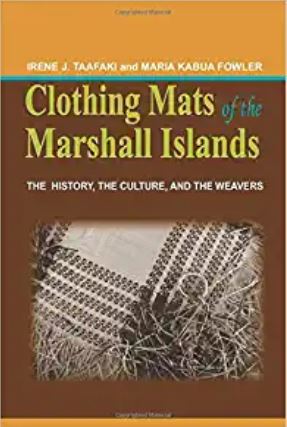
From Clothing Mats of the Marshall Islands: The History, the Culture and the Weavers by Irene J. Taafaki and Maria Kabua Fowler (Mājro, 2019). Available via Amazon.
Excerpted with permission of the authors.