 The Ministry of Education, Sports and Training (MOEST) is the government branch responsible for all public schools in the Marshall Islands. Within the MOEST sits the Public School System (PSS), established in November 2013 by Public Law 2013-23, and headquartered in Majuro.
Education is modeled after the US system, and some funding comes from the US Department of the Interior and the US Department of Education. Schooling is compulsory from ages 6 to 14 with instruction in both Marshallese and English.
The PSS operates elementary schools across Majuro and the outer atolls, as well as seven secondary schools. A four-year program covers general studies, college preparatory courses, and vocational training.
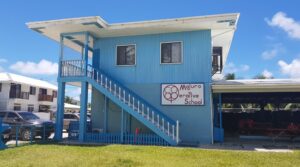 Private schools play a significant role in the Marshall Islands education landscape, and most are affiliated with religious organizations.
The largest and most well-known are the Seventh-day Adventist (SDA) school in Delap and the Catholic school Assumption in Uliga, but there are numerous other schools with religious ties.
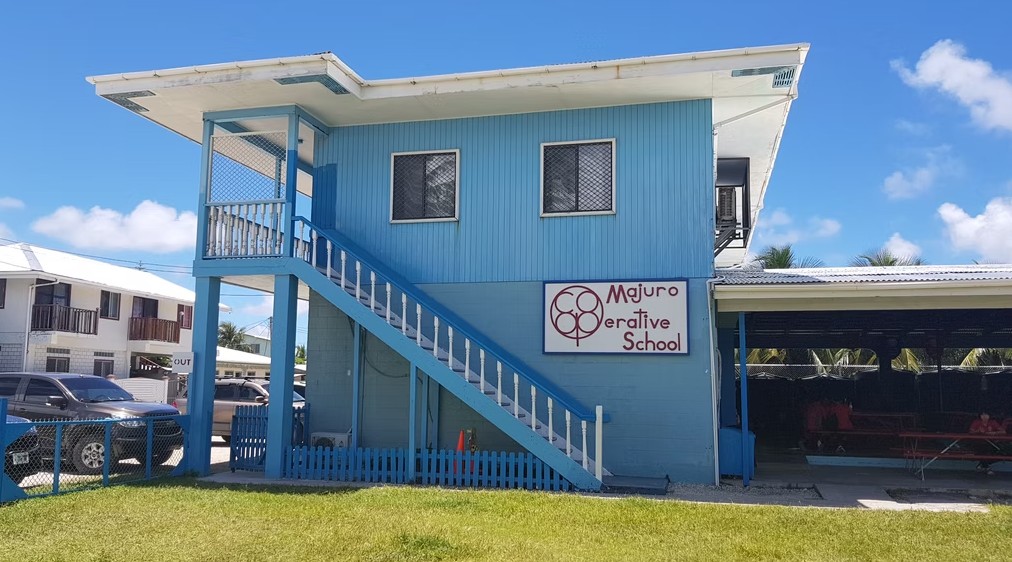
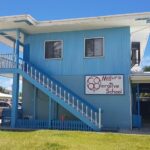
Then there is the Majuro Cooperative School — known simply as “Co-op” — which stands apart as the only non-religious private school in the country. Co-op was founded in 1975 by a small group of concerned parents who wanted to provide their children with a quality education, starting as a one-teacher school with a single classroom. Today it has grown considerably: it serves approximately 350 students in grades PreK-12, uses a US-based curriculum, and offers core academic courses plus extracurricular activities in sports and the arts.
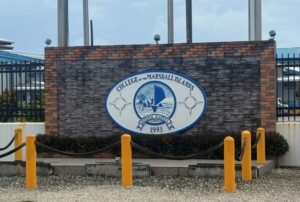 Higher education in the Marshall Islands consists primarily of vocational and tertiary instruction at two institutions. The College of the Marshall Islands (CMI), is the main post-secondary institution, offering associate degrees in sciences and liberal arts, a range of professional certificates, and adult education programs for those seeking a high school equivalency. The college’s main campus is in Uliga. Its “branches” are Arrak Campus (near Laura on Majuro), Kwajalein Campus, Jaluit Center, Wotje Center, and Santo Sub-Center (at Kwajalein).
The University of the South Pacific’s Marshall Islands campus offers bachelor’s degree programs and a master’s in business administration. They also cover other fields depending on the semester. For example, in December 2025, 15 students finished Master’s in Education.
Despite these options, higher education remains out of reach for many with only a small percentage of the population graduating from college. A significant challenge is college readiness: A large number of incoming CMI students are placed into developmental courses as they are not yet ready for postsecondary work.